What Is Semantic Cannibalization? A Complete Guide (And How to Fix It)
Imagine this.
You publish more content.
You target more keywords.
You do “everything right” in SEO.
Yet your rankings stall.
Traffic doesn’t grow.
And Google seems confused about which page to rank.
That’s not bad SEO.
That’s semantic cannibalization.
And if you don’t fix it, your own content will keep fighting itself.
Let’s break it down, clearly, simply, and practically.
What Is Semantic Cannibalization?
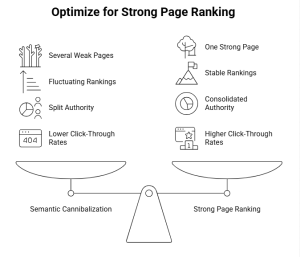
Semantic cannibalization happens when multiple pages on your website target the same search intent, even if the keywords are different.
They don’t look identical.
But to Google, they mean the same thing.
So instead of one strong page ranking well, you end up with:
-
Several weak pages
-
Fluctuating rankings
-
Split authority
-
Lower click-through rates
In short:
Your pages steal relevance from each other.
Semantic Cannibalization: Quick Breakdown Table
| Aspect | Healthy SEO Structure | Semantic Cannibalization |
|---|---|---|
| Search Intent | One clear page per intent | Multiple pages target the same intent |
| Keywords Used | Different keywords with different meanings | Different keywords with the same meaning |
| Google’s Understanding | Clear authority and relevance | Confusion about which page to rank |
| Rankings | Stable and improving | Fluctuating and inconsistent |
| Authority | Concentrated on one strong page | Split across multiple weak pages |
| Traffic | Compounds over time | Stagnates or declines |
| User Experience | Clear, helpful, focused | Repetitive and overlapping |
| CTR (Click-Through Rate) | Higher | Lower |
| SEO Outcome | Page 1 potential | Stuck on page 2 or bouncing |
Why Semantic Cannibalization Is a Real SEO Problem
Google wants clarity.
When it sees multiple pages answering the same question, it doesn’t know:
-
Which page is the best answer
-
Which one deserves authority
-
Which one should rank consistently
So it hedges its bets.
That means:
-
Rankings jump up and down
-
Pages rank on page 2 instead of page 1
-
Traffic spreads thin instead of compounding
You worked hard for that content.
Semantic cannibalization quietly wastes it.
Keyword Cannibalization vs Semantic Cannibalization
This is important.
Keyword cannibalization = same keyword, multiple pages
Semantic cannibalization = same meaning, different keywords
Example:
-
Page A: “SEO Content Strategy”
-
Page B: “How to Plan SEO Content”
-
Page C: “SEO Content Planning Guide”
Different keywords.
Same intent.
To Google, these pages are duplicates in disguise.
That’s semantic cannibalization.
How Semantic Cannibalization Hurts You
Let’s make it tangible.
If your site has semantic overlap, you’ll often see:
-
Multiple URLs ranking for the same query (but none strongly)
-
One page ranking one week, another the next
-
Declining average position over time
-
Lower dwell time and engagement
And here’s the painful part:
You might already have the right content.
It’s just competing with itself.
How to Identify Semantic Cannibalization
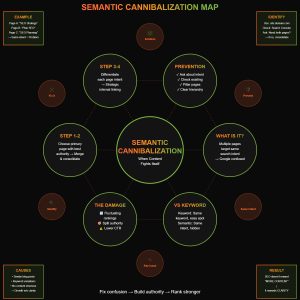
semantic-cannibalization-infographic
You don’t need fancy tools to start.
1. Google Search Test
Search:
If multiple pages show up for the same intent, that’s a red flag.
2. Google Search Console
Look for:
-
Multiple pages getting impressions for the same query
-
Rankings fluctuating between URLs
3. Ask One Simple Question
For each page, ask:
“Would a user need both of these pages?”
If the answer is no, Google thinks the same.
Read more: Traditional SEO vs New SEO (GEO) in 2026
Common Causes of Semantic Cannibalization
This problem usually comes from good intentions.
-
Publishing similar blog posts over time
-
Creating separate pages for slight keyword variations
-
Over-optimizing for SEO instead of intent
-
No clear content hierarchy (pillar + cluster)
In other words:
Growth without structure creates confusion.
How to Fix Semantic Cannibalization (Step-by-Step)
Here’s the part you actually care about.
1. Choose One Primary Page
Decide which page:
-
Best satisfies the search intent
-
Has the most backlinks or authority
-
Converts better
This becomes your main page.
2. Merge & Consolidate
Take supporting content from weaker pages and:
-
Merge it into the main page
-
Improve depth, clarity, and usefulness
Then redirect the weaker URLs to the main one.
3. Differentiate Intent (If Keeping Multiple Pages)
If pages must stay separate, make intent crystal clear.
Example:
-
One page = beginner guide
-
One page = advanced strategy
-
One page = tool comparison
No overlap. No confusion.
4. Use Internal Linking Strategically
Tell Google what matters most.
-
Link related pages to the main page
-
Use clear, descriptive anchor text
This reinforces authority instead of splitting it.
How to Prevent Semantic Cannibalization Going Forward
Prevention is easier than cleanup.
Before publishing, always ask:
-
What exact intent does this page serve?
-
Do I already have content answering this?
-
Where does this fit in my content structure?
Create:
-
Pillar pages (broad topics)
-
Supporting cluster content (specific angles)
One topic.
One main authority page.
Everything else supports it.
The Bottom Line
Semantic cannibalization doesn’t look dangerous.
But it quietly:
-
Weakens rankings
-
Dilutes authority
-
Slows organic growth
The fix isn’t more content.
It’s clearer intent and smarter structure.
When every page has a unique purpose, Google rewards you.
Want Help Fixing Semantic Cannibalization?
If your rankings are unstable…
If traffic is stuck…
If your content isn’t compounding…
There’s a strong chance semantic cannibalization is holding you back.
Audit your website & content. Consolidate what overlaps.
And turn confusion into authority.
Because SEO doesn’t reward “more.”
It rewards clarity.