The Rise of Agentic AI: How Autonomous Systems Will Redefine Work in 2026
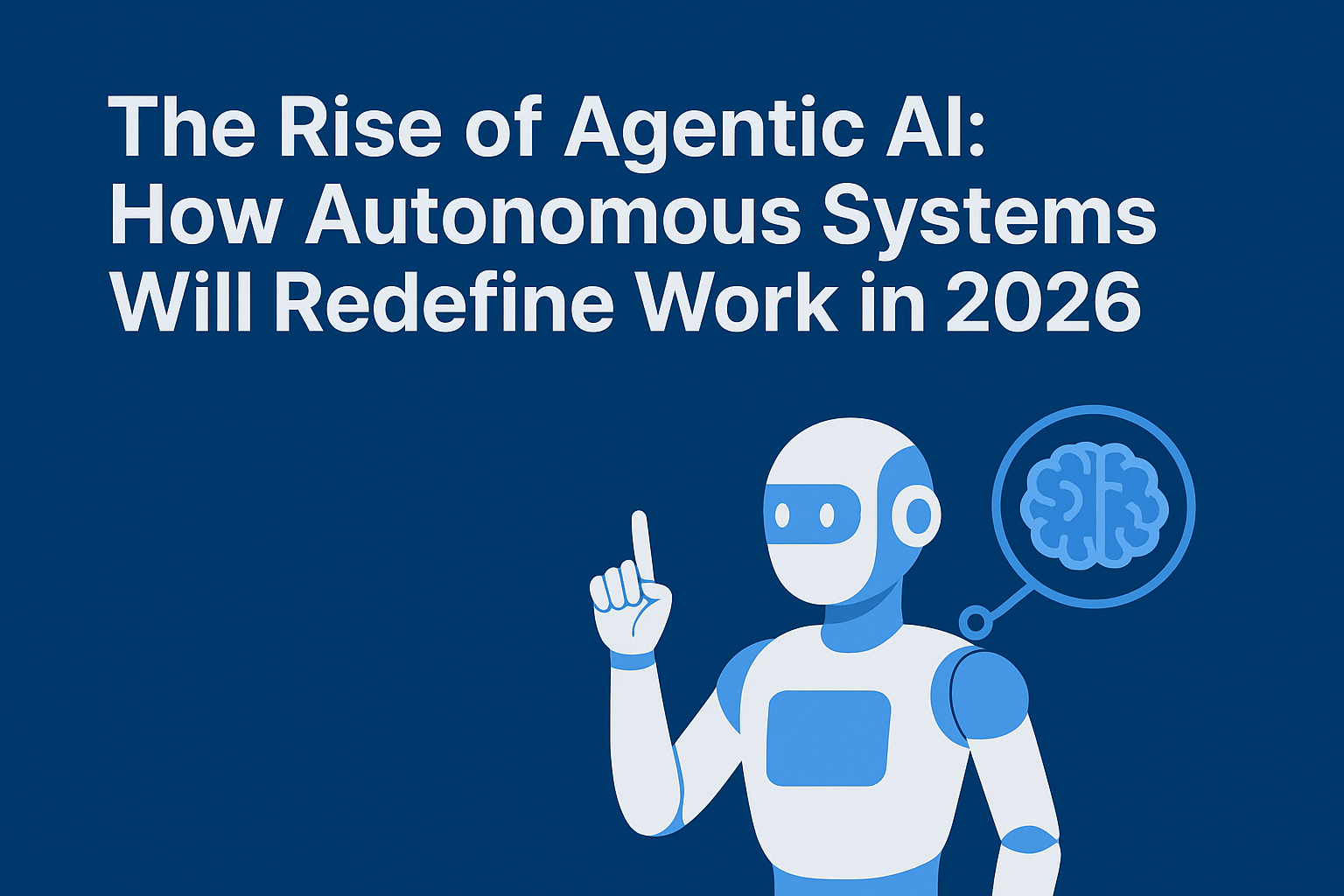
Artificial Intelligence has evolved faster in the past five years than in any other period of technological history. We’ve gone from narrow AI systems that execute predefined commands to a new era: Agentic AI, where machines can think, plan, and act autonomously to achieve complex goals.
By 2026, this evolution will redefine the nature of work, business operations, and decision-making across industries. Companies will move from AI-assisted to AI-empowered workflows, where autonomous systems act as digital coworkers rather than simple tools. Understanding this shift now is crucial for leaders, innovators, and professionals preparing for the next wave of intelligent automation.
Key Takeaways
-
Agentic AI marks a shift from command-based to self-directed systems that think, learn, and act independently.
-
By 2026, autonomous AI agents will play active roles in operations, marketing, finance, and innovation.
-
Successful adoption requires governance frameworks, AI readiness, and workforce training.
-
Businesses must balance efficiency with ethics, data privacy, and accountability.
-
The organizations that embrace Agentic AI early will lead the next wave of intelligent automation and digital transformation.
What Is Agentic AI?
Agentic AI refers to artificial intelligence systems that go beyond passive instruction. These agents can perceive, reason, and act independently within defined parameters to achieve specific objectives.
Unlike traditional AI models that rely on human input for each command, agentic systems use advanced planning, contextual understanding, and self-optimization. They can perform continuous tasks, adapt to changes, and collaborate with both humans and other AI systems in real time.
Key entities and technologies driving Agentic AI include:
-
Large Language Models (LLMs): Systems like GPT, Gemini, and Claude that understand and generate human-like language.
-
Autonomous Agents: Self-directed AIs capable of executing multi-step goals (e.g., OpenAI’s AutoGPT, Meta’s AI Agents, or Anthropic’s Claude Agents).
-
Reinforcement Learning: Algorithms that allow systems to improve performance through feedback and experience.
-
Multi-Agent Collaboration Frameworks: AI ecosystems where multiple agents coordinate, negotiate, and share data to solve complex problems.
Core Technologies Behind Agentic AI
1. Autonomous Agents and Multi-Agent Systems
Autonomous agents use LLMs combined with reasoning and memory systems to perform multi-step tasks. Multi-agent environments allow collaboration between multiple AIs to solve goals more efficiently, such as supply chain optimization or autonomous R&D.
2. Neural-Symbolic Reasoning
Agentic AI blends deep learning (for pattern recognition) with symbolic reasoning (for logic and planning). This hybrid model allows systems to not only recognize data but also understand abstract relationships and make informed decisions.
3. Cognitive Architectures
Modern agents are built using architectures inspired by human cognition, such as memory layers, goal stacks, and attention mechanisms. Frameworks like LangChain, AutoGen, and MetaGPT allow these systems to plan and reason autonomously.
4. Contextual Memory and Continuous Learning
Unlike static models, agentic systems retain memory of past interactions, adapting based on performance and feedback. This creates persistent agents capable of long-term collaboration with humans or other machines.
5. Integration with Internet and APIs
Agentic AIs can use web search, access live data, execute code, or connect to external APIs — bridging the gap between digital environments and real-world applications.
How Agentic AI Will Redefine Work by 2026
1. Autonomous Digital Workforce
In 2026, many companies will deploy AI agents as part of their workforce. These agents will handle repetitive, analytical, and even creative tasks — freeing humans for higher-level strategy and innovation.
Examples include:
-
AI project managers that assign and track tasks.
-
Sales agents that negotiate pricing and contracts autonomously.
-
HR bots conducting preliminary candidate interviews.
2. Intelligent Automation Across Industries
Agentic AI will transform automation from rule-based to adaptive systems that think.
-
Finance: Agents perform fraud detection, portfolio optimization, and financial forecasting.
-
Healthcare: Autonomous systems monitor patient data and coordinate treatments with physicians.
-
Manufacturing: AI agents oversee production lines, adjust processes, and manage predictive maintenance.
3. Human-AI Collaboration Becomes Seamless
Workplaces will no longer separate human and AI tasks. Instead, agentic systems will integrate into team workflows. For instance, a marketing department might include two human strategists and three AI agents collaborating on campaign data, creative content, and performance analysis.
4. Decision-Making and Predictive Insights
Agentic AI systems will leverage massive data volumes to provide decision support. By analyzing multiple scenarios simultaneously, they’ll deliver predictive outcomes faster than human analysts could ever achieve.
5. Personalized Workflows
Every employee could have their own “AI co-agent” trained on their preferences and tasks. This agent will anticipate needs, schedule activities, summarize information, and even negotiate priorities on behalf of the user.
Industries Poised to Benefit Most from Agentic AI
1. Finance and Banking
Agentic AI agents will handle algorithmic trading, compliance checks, credit assessments, and customer service through intelligent chat systems that understand tone and intent.
2. Healthcare
From diagnostics to drug discovery, AI agents will help medical professionals process massive datasets, identify anomalies, and streamline administrative tasks.
3. E-Commerce and Marketing
Autonomous marketing agents will analyze customer behavior, create ad copies, optimize SEO, and run A/B tests—constantly improving performance.
4. Manufacturing
Factories will deploy agentic control systems to monitor machinery, detect faults, and ensure efficiency through real-time communication between robotic systems.
5. Education and Training
AI tutors and learning agents will personalize lessons, track student progress, and adapt content in real time based on engagement data.
Challenges and Ethical Considerations
1. Accountability and Control
When an AI acts autonomously, who is responsible for errors or harm? Businesses must develop governance frameworks to define responsibility boundaries between humans and machines.
2. Data Privacy and Security
Agentic systems often access sensitive data. Ensuring compliance with regulations like GDPR, CCPA, and upcoming AI-specific laws will be vital.
3. Job Displacement Concerns
While agentic AI creates efficiency, it may also replace some jobs. However, new roles such as AI operations managers, ethicists, and automation architects will emerge.
4. AI Bias and Transparency
Autonomous decisions must be explainable. Companies must ensure their agents operate under ethical AI principles with clear accountability logs and transparent actions.
5. Technical Reliability
AI agents must be tested for consistency, security, and real-world adaptability. Failure in autonomous decision loops could lead to serious consequences in critical industries.
How Businesses Can Prepare for Agentic AI in 2026
1. Conduct an AI Readiness Assessment
Evaluate which business functions can safely adopt agentic systems. Identify where autonomy adds value without introducing risk.
2. Invest in AI Infrastructure
Build cloud-based, API-accessible environments where AI agents can safely execute actions and communicate with enterprise systems.
3. Create Governance and Oversight Frameworks
Develop ethical guidelines, risk assessment models, and audit trails for autonomous decisions.
4. Upskill Your Workforce
Train employees to collaborate with AI tools, manage agentic systems, and interpret AI-generated insights.
5. Partner with AI Vendors and Researchers
Collaborate with tech providers specializing in agentic frameworks like OpenAI, Anthropic, Google DeepMind, and Meta AI. Early partnerships give access to innovation and pilot programs.
The Future of Agentic AI Beyond 2026
By 2026, agentic AI will enter mainstream adoption, but its evolution will continue. Future advancements could include self-improving cognitive agents, AI governance ecosystems, and cross-domain cooperation between agents globally.
In the longer term, expect the rise of AI marketplaces, where autonomous agents trade data, services, and solutions independently creating a new digital economy.
Summary
Agentic AI represents the next leap in artificial intelligence where systems are no longer mere tools but independent collaborators. As these autonomous systems integrate into every layer of business, they will reshape how organizations operate, make decisions, and deliver value. The companies that prepare early by upgrading their infrastructure, governance, and workforce will gain a strategic edge in the new digital ecosystem of 2026.